 11
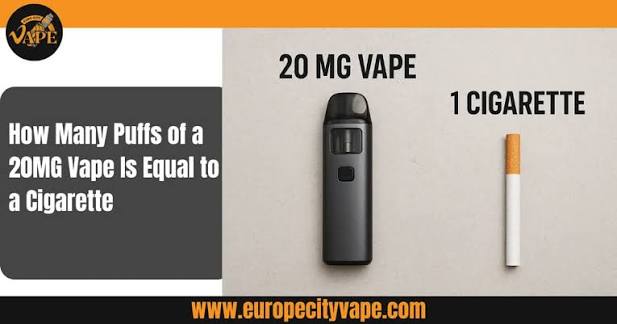
One of the most common questions among people researching disposable vapes is: How many cigarettes are in a 20K vape?
A 20K vape is an electronic cigarette advertised to deliver up to 20,000 puffs. Because this number is much higher than the number of puffs typically taken from a single traditional cigarette, many people wonder whether one device is equivalent to several packs of cigarettes.
The answer depends on what you mean by equivalent. Comparing the number of puffs is different from comparing nicotine intake, and neither calculation provides a perfect measure of health risks.
A 20,000-puff vape could theoretically provide as many as 1,300–2,000 cigarette-like puffs if you assume 10–15 puffs per cigarette. However, this is only a mathematical comparison. It does not mean that the device delivers the same nicotine dose or produces the same health effects as that number of cigarettes.
To understand the actual comparison, you need to consider the vape’s e-liquid capacity, nicotine concentration, device performance, and how frequently it is used.
In this guide, we explain how cigarette equivalents are estimated, how nicotine strength affects the calculation, and what to know about the health risks of high-capacity vapes.
A 20K vape advertises a maximum of approximately 20,000 puffs. Using a simple puff-count comparison, we can estimate its cigarette equivalent.
A traditional cigarette is often smoked over approximately 10–15 puffs, although the number varies significantly between smokers.
Using these assumptions:
This gives a theoretical range of approximately 1,333–2,000 cigarettes based on puff count alone.
However, this calculation has an important limitation. Vape puffs and cigarette puffs do not necessarily deliver equal amounts of nicotine. Vape puff duration, aerosol production, nicotine concentration, and user behaviour can all influence nicotine exposure.
Therefore, the result should not be interpreted as proof that a 20K vape contains the same nicotine dose as 1,333–2,000 cigarettes.
A standard cigarette pack contains 20 cigarettes in many markets. Using the puff-count estimate above, the calculation becomes:
| Comparison | Estimated equivalent |
| 1 cigarette pack | 20 cigarettes |
| 1,333 cigarettes | Approximately 67 packs |
| 2,000 cigarettes | 100 packs |
Based strictly on puff count, a 20K vape could represent approximately 67–100 packs of cigarette-like puffs.
These numbers are theoretical, not measured nicotine equivalents. They also do not mean that using one vape is medically equivalent to smoking that many cigarettes.
For a more meaningful comparison, it is necessary to examine the nicotine contained in the vape liquid and the amount actually absorbed by the user.
The term “20K” generally refers to an advertised maximum of 20,000 puffs.
Manufacturers use puff counts to communicate the potential longevity of a device. However, the advertised figure should not be treated as a guaranteed number of usable puffs under every condition.
The actual number can vary depending on several factors:
For these reasons, two people using the same 20K vape may experience different device lifespans.
It is also important to distinguish the advertised puff count from the device’s nicotine content. A 20K vape does not automatically contain more nicotine per puff than every smaller vape.
Nicotine strength is one of the most important factors when estimating nicotine exposure from an electronic cigarette.
Vape labels commonly express nicotine concentration as milligrams per millilitre (mg/mL) or as a percentage. For example, 20 mg/mL represents 20 milligrams of nicotine per millilitre of e-liquid.
A product labelled 5% nicotine may correspond to approximately 50 mg/mL when the percentage is expressed on a weight-per-volume basis, although the exact relationship depends on how the manufacturer defines and reports the concentration.
You can estimate the total nicotine contained in the liquid by multiplying its volume by its nicotine concentration.
Formula:
Total nicotine in milligrams = e-liquid volume in millilitres × nicotine concentration in mg/mL.
Consider the following hypothetical examples:
| E-liquid volume | Nicotine strength | Total nicotine in liquid |
| 10 mL | 10 mg/mL | 100 mg |
| 20 mL | 20 mg/mL | 400 mg |
| 20 mL | 50 mg/mL | 1,000 mg |
| 25 mL | 20 mg/mL | 500 mg |
These examples illustrate why two devices advertising the same number of puffs may have very different total nicotine contents.
The figures represent nicotine present in the liquid, not the amount that necessarily enters the bloodstream. Some nicotine remains in the device or liquid, while the amount delivered to the user depends on aerosol production, inhalation, and absorption.
Consequently, total nicotine content alone cannot establish an exact cigarette equivalent.
There is no universally reliable cigarette-equivalent number for a 20K vape because products differ in nicotine strength, liquid capacity, and nicotine delivery.
For context, research reviews commonly estimate that smoking one conventional cigarette delivers approximately 1–1.5 mg of nicotine into the bloodstream on average, even though the cigarette itself typically contains considerably more nicotine in its tobacco.
An illustrative calculation can demonstrate the difference between nicotine in the liquid and nicotine absorbed from cigarettes.
Suppose a hypothetical vape contains 20 mL of liquid at 20 mg/mL.
This produces a mathematical range of approximately 267–400 cigarettes.
This is not a reliable estimate of the vape’s actual cigarette equivalent. It compares all nicotine present in the liquid with nicotine absorbed from smoking. The two quantities are not directly comparable because not all nicotine in the vape liquid reaches the bloodstream.
A scientifically meaningful comparison would require information about nicotine emissions, absorption, device performance, and real-world usage.
Research on electronic cigarettes confirms that nicotine delivery can vary substantially with liquid concentration, device power, and puffing behaviour.
It is easy to assume that 20,000 puffs automatically translate into a fixed number of cigarettes. However, this approach overlooks important differences between vaping and smoking.
A conventional cigarette burns tobacco and produces smoke containing nicotine, carbon monoxide, and numerous other harmful substances.
A vape heats an e-liquid to produce an aerosol. Although the products work differently, vaping aerosol is not simply harmless water vapour.
A short inhalation and a long inhalation may deliver different amounts of aerosol and nicotine.
Research has found that puff duration and liquid nicotine concentration are important factors affecting nicotine delivery from electronic cigarettes.
A high-capacity vape may use a different coil, battery, airflow system, or liquid formulation from a smaller device.
These design differences can affect how much nicotine is emitted during use.
Some people take frequent, short puffs, while others take longer inhalations with more time between them.
Consequently, the same vape can produce different nicotine exposure in different users.
These factors explain why puff-count conversions should be treated as rough illustrations rather than exact scientific measurements.
The lifespan of a 20K vape depends on actual puff consumption and whether the device can deliver its advertised number of puffs.
If the device genuinely provides 20,000 usable puffs, the following calculations illustrate how long the advertised capacity might last.
| Average puffs per day | Theoretical duration |
| 100 puffs | 200 days |
| 200 puffs | 100 days |
| 400 puffs | 50 days |
| 500 puffs | 40 days |
| 1,000 puffs | 20 days |
These are mathematical estimates, not guarantees of real-world device lifespan.
For example, at 400 puffs per day, 20,000 puffs divided by 400 equals 50 days. Actual duration could be shorter if the device produces fewer puffs than advertised or consumes more liquid per inhalation.
It is also important to remember that a longer-lasting device does not necessarily mean lower nicotine exposure. Frequent vaping throughout the day can maintain or increase nicotine intake even when a device lasts several weeks.
The number of puffs a vape offers does not determine whether it is safe.
Combustible cigarettes expose users to toxic substances generated by burning tobacco. Vaping avoids tobacco combustion, but electronic cigarettes can still expose users to nicotine, fine particles, metals, and other potentially harmful substances.
The health effects depend on the product, frequency of use, and individual circumstances.
The Centers for Disease Control and Prevention (CDC) states that e-cigarettes should not be used by young people, young adults, or pregnant women. Adults who have never smoked or used other tobacco products should not start vaping.
For adults who smoke, completely switching from combustible cigarettes to e-cigarettes may reduce exposure to some harmful chemicals compared with continuing to smoke. However, this does not make vaping harmless, and using both products may preserve substantial risks.
A 20K vape also presents a particular concern because its large advertised capacity may encourage prolonged or frequent use.
Nicotine dependence: Nicotine is addictive. Repeated exposure can lead to dependence and make it difficult to stop using the product.
Increased nicotine exposure: High nicotine concentrations and frequent inhalation can increase the amount of nicotine delivered.
Short-term symptoms: Excessive nicotine exposure can cause nausea, dizziness, headaches, sweating, or a racing heartbeat.
Respiratory exposure: Vape aerosol may contain substances that irritate the lungs and airways.
Uncertain long-term effects: The long-term health consequences of vaping are still being investigated.
Nicotine exposure is particularly concerning for adolescents and young adults because brain development continues into early adulthood.
Anyone experiencing severe symptoms after suspected excessive nicotine exposure should seek urgent medical assistance.
If you want to understand the nicotine content of a particular device, check its packaging and product information rather than relying on the puff count alone.
Look for the following details:
If the nicotine strength or liquid capacity is missing, it may not be possible to calculate the total nicotine content reliably.
Do not assume that every 20K vape contains the same volume of liquid or the same nicotine concentration. Product specifications and regulations vary between manufacturers and markets.
Using an illustrative assumption of 10–15 puffs per cigarette, 20,000 puffs correspond to approximately 1,333–2,000 cigarette-like puffs. This is a puff-count comparison, not an exact nicotine or health-risk equivalent.
With 20 cigarettes per pack, the theoretical puff-count comparison is approximately 67–100 packs. This figure should not be interpreted as an equivalent nicotine dose.
Not necessarily. Total nicotine depends on the e-liquid volume and nicotine concentration. For example, 20 mL of liquid at 50 mg/mL contains 1,000 mg of nicotine before accounting for how much is emitted or absorbed.
Not automatically. The 20K label generally describes advertised puff capacity rather than nicotine strength. A smaller device may have a higher nicotine concentration, while a larger device may contain more total liquid.
It can, depending on the device’s actual performance and the user’s consumption. If it delivers 20,000 puffs, an average of about 667 puffs per day would use that capacity in approximately 30 days.
A vape may contain more total nicotine in its liquid than a single cigarette contains in its tobacco. However, total liquid nicotine and nicotine absorbed from smoking are different measurements, so the quantities should not be compared directly.
For adults who smoke, completely switching to e-cigarettes may reduce exposure to some harmful substances produced by burning tobacco. Vaping still carries health risks, and people who do not use tobacco should not start. The safest option is to avoid both smoking and vaping.
So, how many cigarettes are in a 20K vape?
The answer depends on the type of comparison. Based on a simple assumption of 10–15 puffs per cigarette, a 20,000-puff vape represents approximately 1,333–2,000 cigarette-like puffs, or around 67–100 packs by puff count alone.
However, this calculation does not establish an equivalent nicotine dose. To estimate nicotine content, you need to know the vape’s e-liquid capacity and nicotine concentration. Even then, calculating the amount absorbed by the user requires additional information about the device and how it is used.
The most important takeaway is that a high advertised puff count does not automatically mean a vape is safer, weaker, or equivalent to a particular number of cigarettes. Understanding nicotine content, recognising the risks of dependence, and avoiding unnecessary nicotine exposure are more useful than relying on puff-count comparisons alone.